
Edgefield Court Records After Arrest
The arrest-to-court path in Edgefield County starts with law-enforcement booking and then moves to the South Carolina court system. The Edgefield County Detention Center can answer current custody questions by phone because the official sheriff page for Sheriff Jody P. Rowland says there is no online inmate lookup. Formal court records after a jail arrest are searched through the Edgefield County Public Index and related Judicial Branch portals.
The Edgefield County courthouse profile places the county in the Eleventh Judicial Circuit and identifies the Clerk of Court as The Hon. Charles L. Reel. The Eleventh Judicial Circuit Solicitor prosecutes criminal matters in General Sessions, Family Court juvenile prosecution, and some Magistrate Court criminal charges. For custody and booking status, use the jail record path. For filed charges, case numbers, hearings, and dispositions, use the court path.
Find Edgefield Court Records After Arrest
The Edgefield Public Index is the main online court-record source for charges after arrest. Search by name or case number when available. If the case is very recent, it may not appear before booking, bond, or charging paperwork is entered. For the custody side of the same event, use Edgefield County jail inmate records and the detention phone line.
- Call the detention center at (803) 637-4124 if current jail custody is unknown.
- Decide whether the matter is likely Magistrate Court, Bond Court, or General Sessions.
- Search the Edgefield County Public Index by defendant name or case number.
- Check Edgefield County court rosters for scheduled hearings.
- Contact the Clerk of Court, Magistrate Court, or Solicitor for older records or filings not shown online.
| Field Label | Type | Required | Notes |
|---|---|---|---|
| County path | URL context | Yes | Use the Edgefield Public Index path. |
| Party or defendant name | Text | Usually optional | Use last name and first name when known. |
| Case number | Text | Optional | Best for known citations or filed cases. |
| Court or case type | Filter | Optional | May separate Common Pleas, General Sessions, Magistrate, and related courts. |
| Court rosters | Separate portal | No | Use for upcoming hearing dates and courtroom lists. |
Charges Filed After Jail Arrest
Initial jail charges are arresting-agency allegations. They may come from a warrant, citation, incident report, or officer statement. The court record after an arrest becomes more formal when charges are filed, reviewed, amended, indicted, dismissed, or resolved. General Sessions matters are prosecuted by the Eleventh Judicial Circuit Solicitor, currently identified in the research as Rick Hubbard.
| Document | Plain-English Role | Edgefield Context |
|---|---|---|
| Complaint | Initial accusation or charging paper. | Often tied to early Magistrate or bond-stage records. |
| Information | Prosecutor-filed charging document. | May reflect decisions made after booking charges are reviewed. |
| Indictment | Grand jury charge in a serious criminal case. | Common in General Sessions felony-level prosecution. |
A booking charge and a court charge can differ. The prosecutor may amend, reduce, add, dismiss, or nolle prosse charges as the case develops.
Edgefield Charge Status Records
Charge status terms show where each count stands. They should be read with the case date and court level. A pending charge is not a conviction. A disposed charge has some court outcome, but the outcome must be read carefully because dismissal, nolle prosequi, plea, conviction, and amendment mean different things.
| Status | What It Means |
|---|---|
| Pending | The charge has not reached final disposition. |
| Disposed | The court has entered an outcome for the charge. |
| Dismissed or nolle prosequi | The charge was dismissed or the prosecutor chose not to pursue it. |
| Amended or reduced | The charge changed from the original booking or filing version. |
| Convicted or guilty plea | A finding or plea of guilt was entered. |
| Bound over | A lower-court matter was sent to General Sessions. |
The official Edgefield online payments portal is one of the court-related Public Index tools captured for this page.
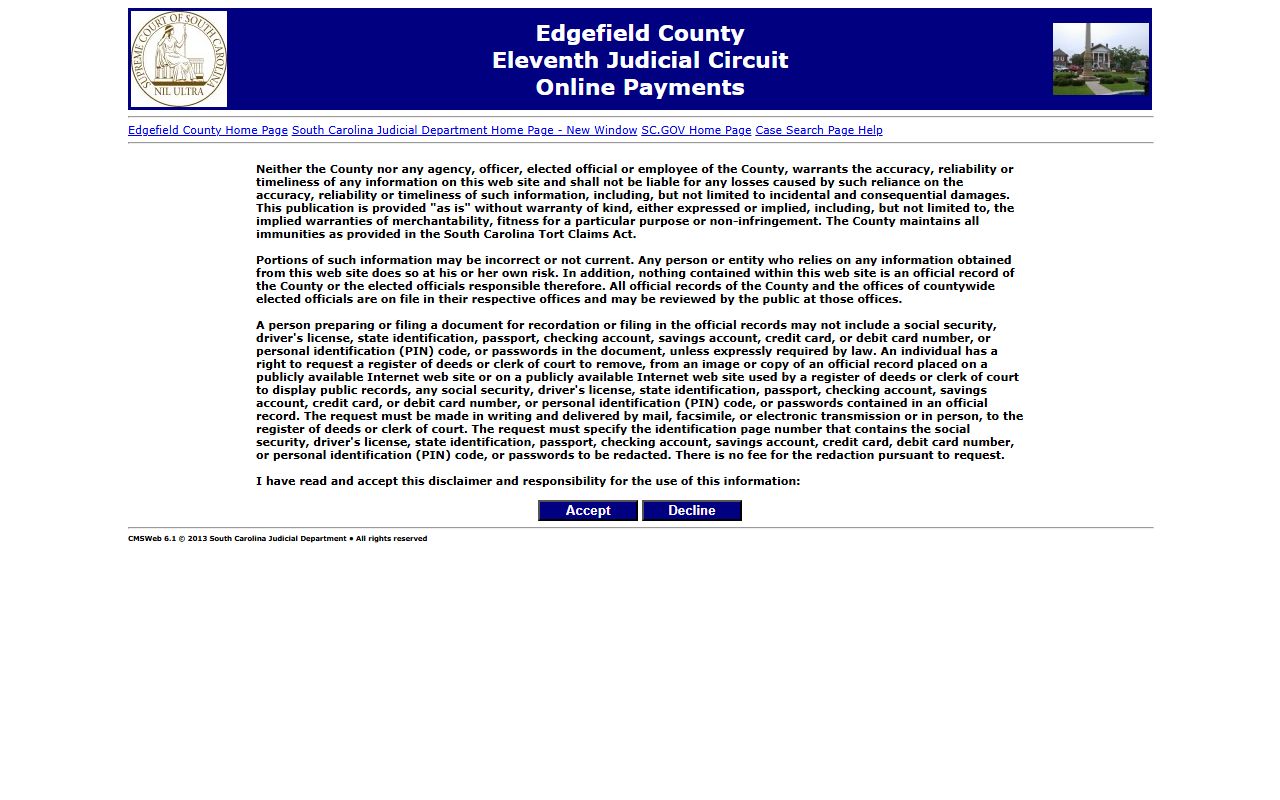
Payment lookup is not the same as a full criminal-history check, but it can confirm that a traffic or criminal citation has entered the court-payment system.
Bond Records After Arrest
Bond information in Edgefield County can sit in several places. The jail can confirm whether a person is held, released, transferred, or blocked by a hold. Magistrate Court handles many misdemeanor and traffic matters and is listed by the county at 264 Star Road with weekday office hours. The Judicial Branch courthouse profile still lists Bond Court at 200 Railroad Street, so confirm the current location before traveling.
| Bond Type | How It Works | Where to Check |
|---|---|---|
| Cash bond | Money is posted directly as ordered. | Detention staff or court channel. |
| Surety bond | A licensed bondsman posts bond under contract. | Ask whether surety is allowed on the specific charge. |
| Personal recognizance | Release on promise to appear. | Set by a judicial officer. |
| No-bond or hold | Release is blocked until a court or agency clears the hold. | Jail, Bond Court, or holding agency. |
Warrants Before Edgefield Arrest
No official Edgefield County active-warrant search was located in the researched sheriff or county pages. A warrant may still produce a jail arrest and court record once the person is booked. The safer route is to contact the issuing court or clerk, search the Public Index for case events, and speak with an attorney when an active warrant may exist.
- Arrest warrant
- A court order authorizing arrest on alleged criminal conduct.
- Bench warrant
- A judge-issued warrant, often tied to failure to appear or court-order violations.
- Search warrant
- A warrant to search a place or property, not a custody roster record.
- Detainer
- A request from another agency to hold or notify before release.
Charges vs Convictions
Edgefield County court records after a jail arrest may show charges long before guilt is decided. A charge is an accusation in a case. A conviction is a final guilt outcome, usually from a plea or trial. Treat both as court records, but do not read them as the same thing.
| Charge | Conviction | |
|---|---|---|
| Stage | Accusation after arrest or filing. | Final guilt outcome by plea or verdict. |
| Meaning | The case is alleged or pending unless resolved. | The court has entered guilt on that count. |
| Record source | Public Index, court file, charging paper. | Disposition or judgment in the court file. |
Sealed and Expunged Records
South Carolina expungement provisions appear in Title 17 Chapter 22, and the South Carolina Judicial Branch publishes an expungement application process. Eligible dismissals or other outcomes may qualify for record clearing. Do not assume that every arrest, charge, or mugshot can be removed, and do not assume private copies vanish just because an official record changes.
| Sealed | Expunged | |
|---|---|---|
| Visibility | Restricted from ordinary public access. | Removed or destroyed as allowed by law. |
| Typical route | Court order or statutory restriction. | Application under South Carolina expungement law. |
| Where to start | Clerk or court handling the case. | Judicial Branch expungement process. |
For booking photos tied to those records, see the neutral records discussion on the Edgefield County jail mugshots page.
Edgefield Court Office Routing
The court office matters because different records are kept by different parts of the system. The Clerk of Court manages General Sessions and related court-file records. Magistrate Court handles many lower-level criminal and traffic matters and publishes Star Road office hours. The Eleventh Judicial Circuit Solicitor makes prosecution decisions for General Sessions matters and some Magistrate Court criminal charges. A court-record request after an arrest should name the case, charge, court level, and record wanted instead of asking one office for every jail and court document.